

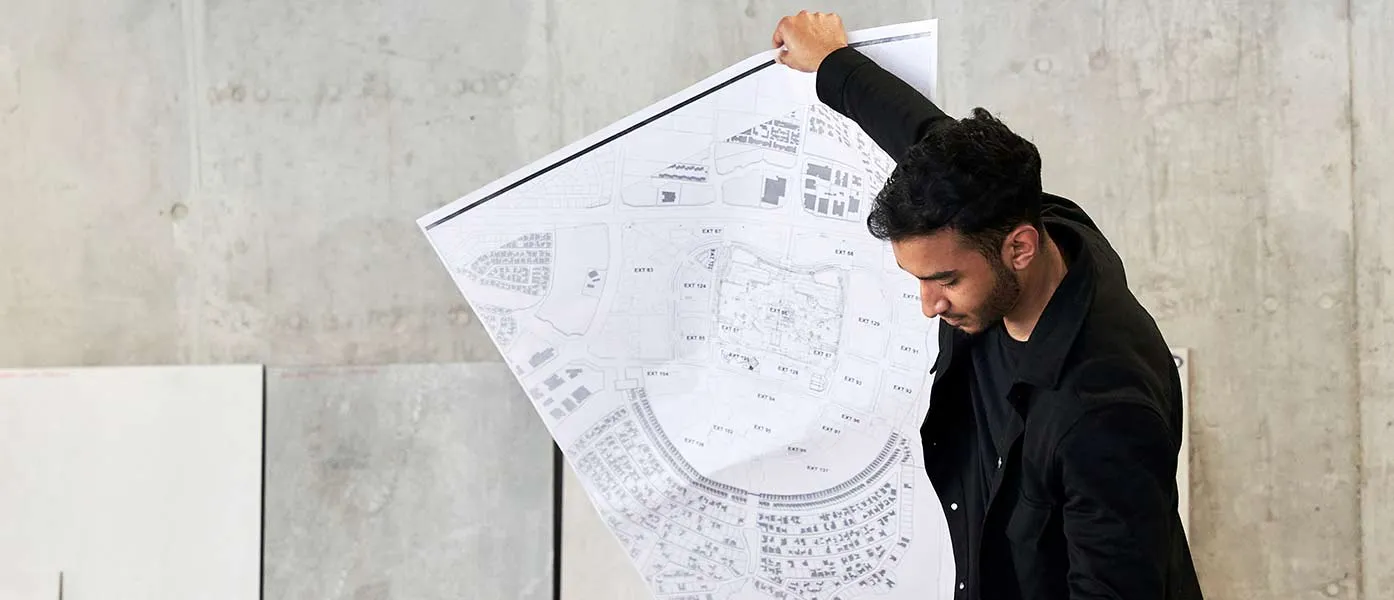
For Graduate Architect Imaad Kamaldien, becoming an architect once felt like an impossible dream. Eight years later, he's a Master of Architecture graduate from the University of Cape Town (UCT) and an integral part of dhk's urban design team. His journey with the studio started in 2018 through Go for Gold, the construction industry skills advancement programme which supports underprivileged Grade 11 and 12 students who show promise and who are interested in architecture. We were one of the early signatories to the programme.
dhk content coordinator Simangele Mzizi (SM): Tell us more about your history with dhk and experience?
dhk graduate architect Imaad Kamaldien (IK): I've been at dhk since my first year out of high school in 2018, interning as part of the Go for Gold student programme.
I’d always aspired to become an architect from an early age, and so my experience over the last eight years has been life-changing. I feel that Go for Gold and dhk have paved the way for me and others to reach incredible academic and professional milestones and for that I’m extremely grateful. I've had the opportunity to complete my undergraduate and postgraduate studies, while being exposed to both architecture and urban design, working with amazing teams and building genuine friendships with colleagues.
SM: Please tell us about some of the projects you’ve worked on at dhk and what’s on your desk at the moment?
IK: So far I've had the privilege of working on a range of projects spread across South Africa, Botswana and Mauritius that entail various stages of work, including urban masterplanning, housing, mixed-use developments and public realm design projects.
Two projects that stand out for me from my first year with the UD team are the Waterfall City Masterplan in Johannesburg and the Belville Public Realm Strategy in Cape Town. I'll always remember the trust that the team had in my capabilities early on; it gave me the confidence and motivation needed to create work that I'm truly proud of.
I've learned an immeasurable amount from the Waterfall City Masterplan project. I’m continuing to work on the project, in its current stages. The Belville CBD regeneration project was enjoyable as we were on the ground, walking the site on multiple occasions with various stakeholders, collaborative teams and community members. This gave us an opportunity to understand exactly what was needed by engaging and responding directly with people and place. It also showed how small incremental changes can have a big impact.
SM: You mentioned that you started with Waterfall in your first year, and now, as a post-graduate, you’re back on it. How does that feel?
IK: Yes, it was the first project I worked on in the UD team. It’s become a special project for me. During my postgraduate years I could see glimpses of its progression as it ventured into the next exciting stage. Fast forward to 2026, it’s a major project in our team and I can look back at the previous stages with gratitude, pride and joy. It’s truly a full circle moment with many more to come.
SM: You’ve become an integral member of the urban design team. What drew you to urban design? And what’s been your experience of being mentored by [dhk Principal] Guy and [Head of Urban Design] Tanya?
IK: After my undergraduate studies, I was given an opportunity to join the dhk urban design team as an intern. Although I hadn't directly investigated urban design as a career path before, in retrospect, I always looked at the broader picture to understand the various systems that are not always visible. I've always been interested in how architecture, urban scales and natural systems work together, and I believe architects and urban designers must understand both to design appropriately within context. Learning from Guy, Tanya and the entire UD team has been an invaluable experience. I'm excited to see where urban design takes me.
SM: How would you describe your approach to design?
IK: My approach to design is one deeply rooted in context, reciprocity and innovation. Throughout my academic career, I've always seen architecture as a mediator between people and place, and I find joy in understanding the unique characteristics and layers embedded within them. My experience at dhk has broadened the lens through which I understand those contextual layers. I love the challenge of responding to the informative design cues that are revealed after a thorough and intuitive process that marks each stage of a project, from analysis and conceptual exploration to synthesis and refinement.
My postgraduate research has focused on how the reciprocal relationships between people and place can inform a responsive design methodology that is sustainable, resilient and accessible, and that integrates innovation and natural systems through materiality, tectonics and functionality. Although it may not always be up to us, I believe we have a great responsibility in our profession to listen, translate and respond to both people and place holistically.
SM: What do you enjoy about the work environment at dhk?
IK: The work environment has always been inspiring, both as a student and as a young professional, which is important for integration and support. I love that dhk celebrates everything from the little wins to the big accomplishments, which creates a good balance between work and social office life. I really enjoy Design Dialogues [an internal platform that facilitates discussions about design-related topics] and hope to attend many more going forward. Then, of course, the annual football tournament has been a highlight outside of work, especially bringing home the trophy for the first time last year.
Overall, I enjoy the fact that dhk is a multidisciplinary design studio where knowledge and expertise integrate seamlessly. At dhk you're surrounded by talented people who show genuine interest in your ideas and are always eager to help, no matter how simple a question might feel. I also enjoy the fact that although dhk is a large firm, the individual voice is never lost, but rather celebrated.
SM: How would you describe the culture at dhk to someone outside the organisation?
IK: Nurturing. Nurturing the future of our industry, knowledge, growth, innovation and relationships through interdisciplinary practice and individual development. I think this is reflected in our work through our understanding of how people engage with the spaces we create and how those spaces relate to their respective contexts, whether it be architecture, interior design or urban design. The office is transparent and honest in the way teams collaborate and share progress, which results in high-quality, consistent work and creates opportunities for individuals to continue growing within the studio.
SM: Any final words?
IK: I would just like to express appreciation for the support over the years leading up to my greatest academic achievement so far. Obtaining my Master’s was a dream that once seemed impossible, before joining Go for Gold and dhk, and for that I'm truly grateful. This is at the core of my motivation to maintain a high work ethic and keep learning as I progress within architecture, urban design and related fields. Now that I'm a Go for Gold alumni, I'm excited to use the skills and lessons gained to help the next generation of students at dhk and UCT through mentorship.


