

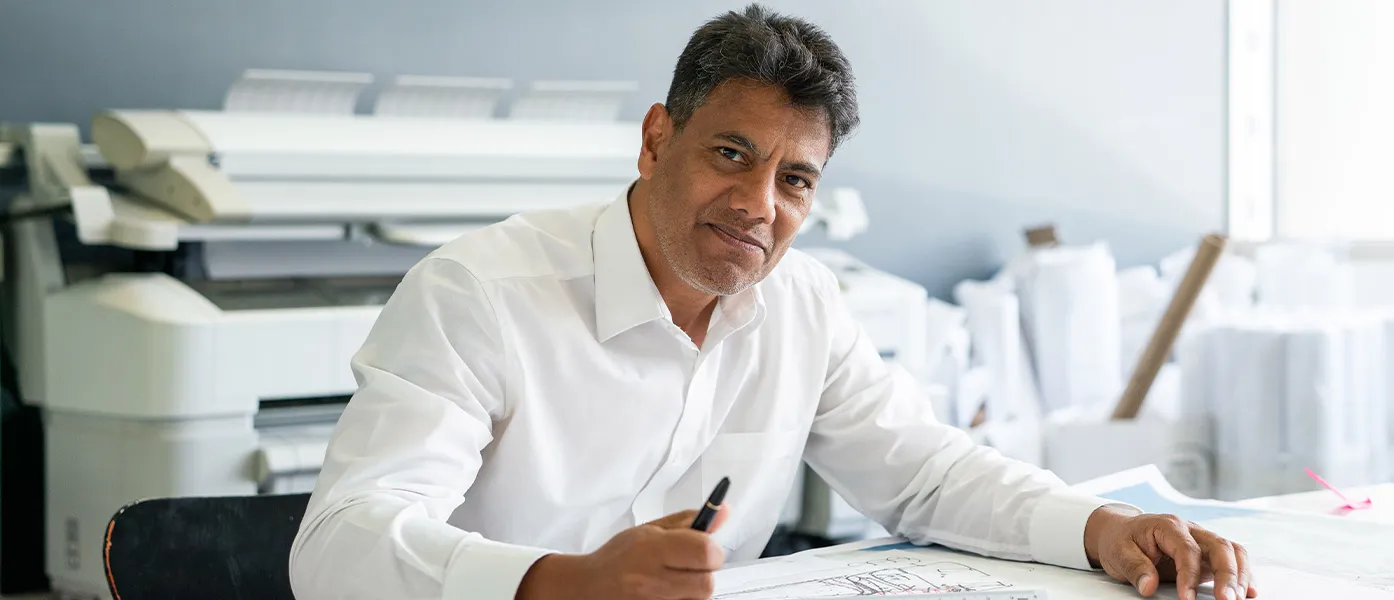
Tell us a bit about your professional journey and what have been the defining moments that shaped where you are today?
I’ve been working in architectural practice for over 30 years, with a strong technical focus on hands-on construction delivery, rigorous technical documentation and practical site administration. I’ve worked in local and international studios, delivering projects in the Middle East, and Western and Southern Africa, across a wide range of sectors, including commercial, retail, residential, hospitality, industrial, educational and medical.
In my previous roles, my career progressed from Senior Architectural Technologist to Associate, and later Director. Each has shaped my approach to leadership, technical execution and project delivery. This has given me broad exposure to different aspects of architectural practice and construction methodologies.
I have a strong interest in sustainability initiatives and skills development within the architectural industry. From 2020 to 2022, I served on the judging panel for the PG Bison Student Initiative, “1SIXONEIGHT,” which was a particularly rewarding experience in supporting emerging talent.
What drew you to dhk?
I was drawn to dhk’s ability to remain progressive while staying grounded in strong architectural principles, long-term thinking and taking a people-centred approach to design. I joined the Johannesburg office in January 2026 as a Senior Associate, with a mandate for coordinating and delivering technical documentation and site administration, while strengthening information flow between concept design, detailed design and construction stages. My role also includes business development, training and development and senior-level operational and office management responsibilities. Since I joined I’ve come to appreciate how we embrace advanced technology and design methodologies, and the studio’s strong collaborative mindset.
What stands out to me is that dhk is not simply focused on producing aesthetically appealing buildings, but on creating architecture that responds to context and supports the environment. There’s a clear emphasis on longevity, both in the way projects are designed and in how the practice adapts and evolves over time.
Being part of the 10N Collective and the broader Egis Group further reinforces this forward-thinking mindset. These global connections reinforce what dhk values in terms of innovation, collaboration and thoughtful design. All of this makes dhk a place where I know I can grow professionally.
Which projects or initiatives are you most excited about right now, and why?
One of the most rewarding aspects of my role at dhk is contributing to projects that are shaping Johannesburg’s evolving urban landscape. I’m currently involved in two significant developments: the Olympus mixed-use development in Sandton and 20 Rosebank in the Oxford Parks precinct. Both projects are exciting in terms of their scale and ambition, but more importantly, both are significant in shaping more integrated, walkable, lifestyle-focused urban environments. Olympus is architecturally striking, with the sculptural twin towers and mixed-use typology, and 20 Rosebank is a high quality commercial development that contributes a refined gateway to the Oxford Parks precinct. Both projects reflect the values that attracted me to dhk’s forward-thinking design, contextual sensitivity and meaningful impact. It’s a privilege to work on developments that will influence the city’s built environment for years to come.
What has surprised you most about the culture at dhk since joining?
The strength of the internal culture, the genuine investment in people and the people-focused approach of senior management. There’s a clear understanding that investing in staff development strengthens the whole studio. There’s a strong emphasis on collaboration, support and continuous learning across all levels, and senior staff are always willing to share their knowledge and experience. Overall, the culture feels progressive, supportive and well-balanced, combining high standards with an environment that encourages growth.
There’s a real culture of mentorship and skills transfer, where learning is embedded in day-to-day work rather than limited to formal structures. I’ve also been impressed by the level of organisational structure and the systems in place to foster greater efficiency, communication and coordination. All of this creates a positive working environment and effective project delivery.
Outside of work, what are you passionate about; what do you do to recharge?
I’m very interested in skills development and sustainability within the architectural industry. I also like travelling internationally and am a keen DIY enthusiast, particularly in woodworking, furniture making, metalworking and composite fabrication. But one of my greatest passions is cars and motorsport, especially restoring and building vintage vehicles and race cars. I’ve been involved in several automotive projects over the years, ranging from detailed restorations to performance builds, some of which have been featured on the covers of local motoring magazines.
These interests combine creativity, engineering and problem-solving. My architectural background naturally translates into the automotive world, where precision and innovation are key. I particularly enjoy developing custom solutions through 3D design and hands-on fabrication.
Motorsport has taught me a great deal about discipline, technical thinking and refinement through iteration, which are principles that apply directly to architecture. It’s a field that continuously challenges me to think creatively while maintaining a high level of craftsmanship and accuracy.
What impact do you hope to have at dhk over the next year or two?
My goal is to make a meaningful contribution to the studio through mentorship, collaboration and continuing to develop technical and professional skills within the team. A key focus for me is strengthening skills transfer, by sharing practical knowledge gained through project delivery, detailing and construction processes. I believe this is essential in developing confident professionals who can contribute meaningfully from an early stage.
I’d also like to encourage a stronger culture of critical thinking among Architectural Technologists, to promote engagement with problem-solving, design intent and buildability, rather than focusing purely on documentation. Another priority is encouraging younger staff to build their professional networks through industry events and collaboration. Exposure to the broader industry is vital for growth.
Finally, I’d like to see greater involvement of Architects and Technologists in site administration and construction processes. Understanding how buildings are assembled, along with the associated responsibilities, is key to developing well-rounded professionals.
Image: William Hindle


